
The deal now involves seven partners. Is your GTM built for that?

Remember when a two-partner campaign felt ambitious?
That benchmark is gone.
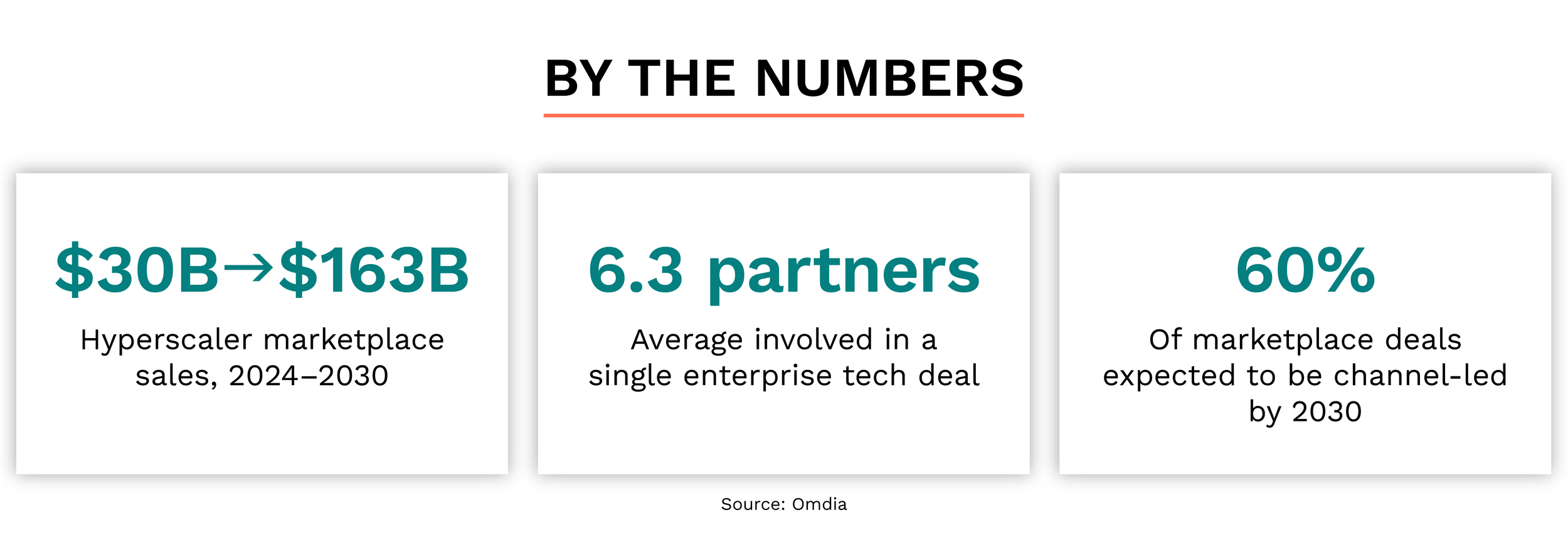
According to Omdia, the average enterprise customer now works with 6.3 partners to fulfill their technology requirements. Jay McBain puts the number at seven or more for complex deals.
The channel motion that most programs and most agencies were designed around doesn’t reflect how buying happens anymore.
The ecosystem has replaced the channel. But many partner programs are still operating like it’s 2018. The gap between how programs are structured and how deals actually close is where revenue leaks out every day.
Now the challenge is orchestration and driving meaningful collaboration.
The market infrastructure is finally catching up
For years, multi-partner selling was strategically obvious, but commercially messy.
How do you structure a deal across three partners? Who owns the customer relationship? How do you transact?
Those questions are now getting answered.
In May 2026, Microsoft expanded multiparty private offers in Marketplace to 30 countries across Europe, with Australia, Japan, and South Africa following in July. Multiparty private offers give publishers and channel partners a structured way to align on commercial terms and transact together through a single motion.
Partner-to-partner-to-partner is no longer just a go-to-market strategy. It’s becoming a supported commercial model at scale.
Omdia projects hyperscaler marketplace sales to grow from $30 billion in 2024 to $163 billion by 2030—a 29.1% CAGR.
There is an estimated $470 billion in cloud commitments sitting across AWS, Azure, and Google Cloud right now, with customers increasingly using those commitments to fund a broader portfolio of partner solutions. In Q2 2025 alone, nearly $30 billion in new commitments were added.
Partners aren’t being cut out of this growth. By 2030, they’re expected to facilitate nearly 60% of all marketplace transactions.
The opportunity is real, but how do partners successfully and repeatably execute on it?
AI is raising the stakes
Agentic AI is projected to be the fastest-growing category through hyperscaler marketplaces—$24.4 billion by 2030, at a 37% CAGR.
The hyperscalers are competing hard to own this channel, and partners are being pulled into that competition, whether they’re ready or not.
What this means practically: more partners in more deals, with higher customer expectations around speed-to-value and outcome delivery.
The orchestration complexity isn’t going away. It’s compounding.
What we’ve learned running these programs
At Knack, we’ve spent over a decade running multiparty co-marketing programs with Microsoft, AMD, Intel, Avanade, Infosys, and others.
We’ve seen what makes them work and what causes them to fall apart.
The ones that fall apart usually have the same problem: too many agendas, no cohesive value story, and no single layer of orchestration that all partners trust. Everyone is optimizing for their own slice instead of the shared outcome.
We’ve seen campaigns where multiple partners agreed on the objective, but showed up with different value propositions, different definitions of success, and different expectations around lead ownership. The result wasn’t collaboration; it was confusion.
When these programs work, it’s because they have clear role definition across partners, messaging that’s coordinated but still unique, and someone accountable for the entire motion, not just their piece of it.
It’s how we’ve been able to drive
400K+ leads. 31x average ROI. >$1B in pipeline.
Not from one program, but from getting the model right across many.
The missing layer in ecosystem GTM
Even well-run partner programs often make critical decisions on instinct.
Which partners are actually ready to co-sell? Where is the real pipeline opportunity?
Which investments will move revenue, and which are relationship maintenance dressed up as strategy?
The data to answer those questions exists, but it’s scattered across market signals, CRM systems, content performance metrics, partner data, and institutional knowledge that walks out the door when people leave. No one has pulled it together into something useful at the decision layer.
The next evolution of ecosystem selling isn’t adding more partners. It’s making better decisions about the partners you already have.
As ecosystems grow, the organizations that win won’t necessarily have the largest networks. They’ll have the clearest visibility into where readiness, opportunity, and investment intersect.
That’s exactly why we’re building readypathAI.
readypathAI is a new partner intelligence platform designed to operate where partner GTM has traditionally run on gut feel.
Ecosystem owners get portfolio-level readiness intelligence on their partners. Partners get a clear, honest picture of where they stand and what to do about it. Investment and timing decisions are validated and supported with objective analysis.
Early preview access is open now.
The organizations that win in the ecosystem won’t be the ones with the biggest partner networks. They’ll be the ones that know how to align, activate, and orchestrate them.
If you’re figuring out what that looks like for your business, let’s talk.
→ Talk to Knack: knackcollective.com
→ Get early access to readypathAI: readypathai.com