
The room where it happens
Why in-person events are the partner marketing channel nobody stopped needing

There’s a moment that happens at every good in-person event. Someone you’ve been emailing for six months walks up to you at a reception, drink in hand, and the conversation that follows does more in twenty minutes than the last two quarters of digital touchpoints combined. If you work in partner marketing, you know exactly what we’re talking about.
For a while, the industry convinced itself that digital could replicate that. It couldn’t. And the data, and every full conference room you’ve walked into this year, is making that pretty clear.
Events never actually went away
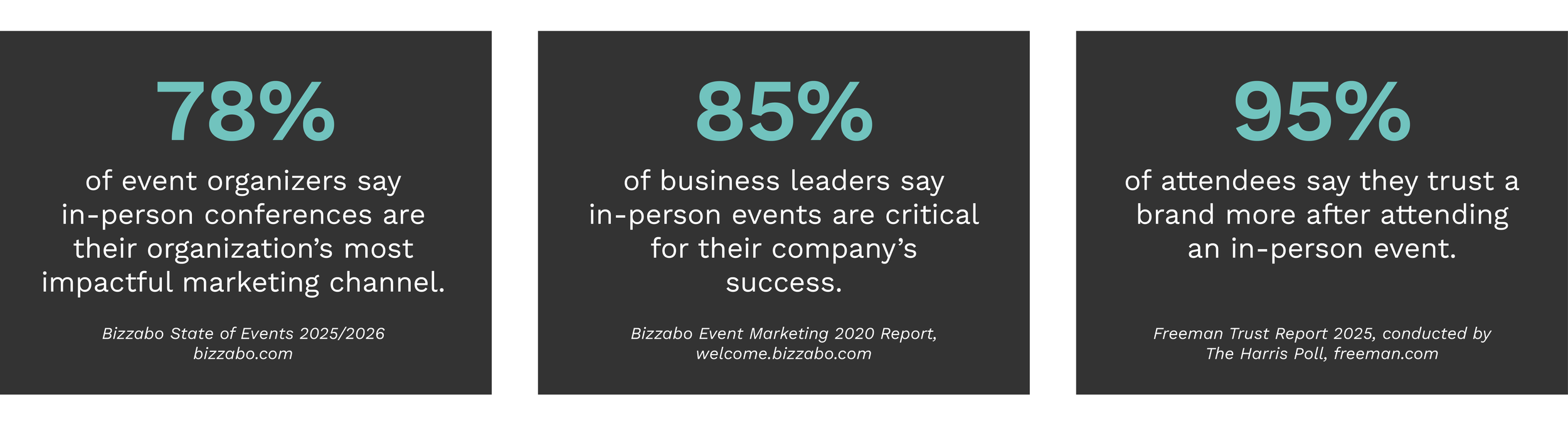
The narrative that “events are back” implies they left. They didn’t. They just got smaller, more expensive, and harder to justify to a CFO staring at a Zoom dashboard with 400 attendees. What’s back is the confidence to invest in them again, and the proof that the investment works.
B2B event spend has been climbing steadily since 2022. Industry research from Event Marketer EventTrack and Statista, puts the global B2B events market on track to reach $1.5T by 2028, driven largely by enterprise demand for experiences that digital channels simply cannot replicate.

In partner marketing specifically, the stakes are higher. You’re not just trying to build a pipeline with one buyer. You’re trying to align multiple organizations: each with their own GTM priorities, their own sales teams, their own definitions of ready, all working toward a shared opportunity. That is an inherently human problem, and it requires a human solution.
Why in-person is table stakes for multi-partner motions
Here’s what nobody says out loud in multi-partner marketing: getting three or four organizations to move in the same direction is genuinely hard. Written briefs, shared Slack channels, and joint webinars are useful. They are not sufficient.
What closes the gap is a room. Specifically, a room where the right people from each organization can talk to each other without the friction of asynchronous communication, siloed inboxes, and competing calendar priorities.
In-person events create something that’s nearly impossible to manufacture digitally: organic alignment. When the Microsoft partner manager, the ISV rep, and the systems integrator are all at the same event, sitting in the same sessions, and ending up at the same dinner. The conversations that happen are not on any content calendar. They’re the ones that move deals.

Research from The 2025 Freeman Trust Report consistently shows that in-person interactions drive measurably higher trust scores and faster decision-making cycles than digital-only engagement. In a co-sell motion with three or more partners, where the sales cycle is already complex, that trust premium isn’t a nice-to-have. It’s what determines whether the deal closes this quarter or next year.
What’s working in events right now
Not all in-person investment is equal. Here’s what we’re seeing that actually moves the needle. And what’s theater.
What’s working
Smaller, curated gatherings over massive trade show booths. Executive roundtables, partner dinners, and hosted buyer programs consistently outperform booth presence for relationship depth.
Events timed to a buying moment. Partner-hosted field events that coincide with a product launch, program announcement, or fiscal quarter deadline have a clear call to action that makes follow-up straightforward.
Hybrid presence done selectively. Livestreaming a session is not the same as attending. The most effective teams use digital to amplify, not replace. Broadcast key moments to audiences who couldn’t attend, while keeping the in-room experience high-value.
Multi-partner event programming. Joint sessions, co-branded field events, and partner ecosystem tracks at major conferences let you put all your logos in one room and let the audience draw their own conclusions about your ecosystem’s depth.
What’s theater
Big booths with no follow-up strategy. Presence without post-event process is brand awareness at best.
Swag and spectacle without substance. Attendees remember the conversation, not the tote bag.
Event presence that isn’t connected to the rest of the GTM motion. If your sales team doesn’t know what happened at the event, the leads will die in someone’s inbox.
The part everyone gets wrong: Orchestration
The event itself is the easy part. What most partner marketing teams underinvest in is everything around it. That’s where the ROI lives or dies.
Before the event
Who is attending from each partner organization? What conversations do you want to happen? Between whom? What does a successful outcome look like, and how will you know if it happened? These questions need answers before anyone boards a plane.
In a multi-partner context, this is even more critical. Briefing each partner’s attending team on the shared narrative, the joint messaging, and the specific accounts or opportunities in the room is the difference between a coherent partner presence and three organizations accidentally stepping on each other’s messaging.
During the event
Designate a connector. Someone whose explicit job at the event is to facilitate introductions, identify the conversations worth having, and make sure the right people end up in the same place at the right time. This is often an underrated role in partner marketing. Also one of the highest-leverage ones.
After the event
This is where most programs fall apart. The event ends. People fly home. Monday arrives. And the follow-up—if it happens at all—is a generic “great to meet you” email that does nothing.
Best-in-class partner event follow-up is:
Personalized to the specific conversations that happened in the room, not a template
Coordinated across partner teams so the prospect isn’t getting four different emails from four different organizations with four different next steps
Fast: within 48 hours, while the relationship is still warm
Connected to a clear CTA that reflects where that relationship actually is, not where a generic nurture sequence assumes it is

The data backs this up. A 2025 HockeyStack study of 198 B2B SaaS companies found that 72% of marketers say prospects close deals faster after attending an event—and 52% attribute at least half of their closed-won deals to events entirely. Neither of those numbers happens without a follow-up process that actually works.
The authenticity advantage
There’s a subtler reason in-person events matter that rarely makes it into the ROI conversation: authenticity.
Even good digital marketing has a polish to it that creates distance. The curated post, the produced webinar, the edited case study. All useful. All a little bit rehearsed.
In-person events are where people see you think on your feet. Where the unrehearsed answer to a hard question tells someone more about your organization than any content piece ever could. Where the fact that you showed up—that you were in the room. It signals something that a LinkedIn impression cannot.
In a channel environment where more partners are competing for mindshare, attention, and co-sell priority, that authenticity is a genuine differentiator. The partners and prospects who matter most are being marketed to constantly. What they’re not getting is a real conversation with someone who knows the business, cares about the outcome, and took the time to be there.

Making it work with a lean team
The objection we hear most: “We don’t have the bandwidth to do events well.” Our response: you don't have the bandwidth to do events poorly either, because the cost of a poorly orchestrated event, in budget, relationship capital, and opportunity cost, is real.
The answer isn’t to do more events. It’s to do fewer events better. That means:
Choosing events that concentrate the right people in one room, not events that look good on a recap slide
Building a repeatable playbook for pre-event, during-event, and post-event execution so you’re not reinventing the process every time
Aligning with your partner teams early enough that the event logistics aren’t eating your strategy budget
Measuring outcomes that actually connect to pipeline: conversations had, introductions made, next steps set—not just badge scans
The bottom line
Events are back. The smarter framing is that they never went away for the teams who understood what they were actually for. They’re not brand awareness plays. They’re not content opportunities. They’re relationship infrastructure, and in partner marketing, where the whole motion depends on trust between organizations that don’t share an org chart, that infrastructure is foundational.
The teams winning in partner GTM right now are the ones treating events as a system—with deliberate orchestration before, a clear job to do during, and a disciplined follow-up after. The room is only as valuable as what you do with it.
We’ve seen this firsthand. When we partnered with Microsoft to modernize their global events program—spanning Ignite, Build, and a long tail of field and partner activations—the events themselves were already strong. What was missing was the system underneath them. Planning happened in silos. Measurement stopped at attendance. Each event worked on its own, but together they added up to a lot of operational lift with limited visibility into which ones were actually driving business outcomes. The work wasn’t to change the events. It was to build the connective tissue: a unified portfolio framework, a modular delivery model with repeatable playbooks, and an attribution approach that tied event activity back to pipeline. The result was a program that could finally be measured, optimized, and scaled. It also laid a foundation for AI-driven planning when the time came. That’s what treating events as a system actually looks like at scale.
Want to talk through how to build a partner event strategy that actually converts? Let’s get in a room.